A technology plan your business can execute
IT Strategy and Digital Transformation Consulting
Elatre helps leadership teams decide which technology investments to make, what to modernize and how to deliver the work. We connect business priorities, architecture, budgets and operating responsibilities in a practical roadmap that engineering and business teams can execute together.

Make the next technology decision clear
Elatre provides IT strategy consulting for organizations facing competing technology investments, disconnected systems or a transformation program without a clear delivery path. The work turns business priorities into documented architecture choices, funded workstreams and accountable decisions.
A business can have a cloud plan, an ERP plan and an AI plan that each look reasonable but cannot be delivered together. They may require the same people, depend on data that is not ready or assume that another department will change its process first. We make those connections visible before they become expensive delivery problems.
The starting question is practical: what must the organization be able to do that it cannot do reliably today? That might be integrating an acquisition, serving customers across regions, reducing dependence on a legacy application or giving leaders a consistent view of performance. The strategy records the business outcome and the decisions needed to support it.
This service owns the portfolio roadmap, target architecture and delivery model. Implementation remains a defined workstream with its own scope and acceptance tests. For example, an ERP decision can lead into SAP consulting and S/4HANA implementation, while a reporting decision may lead into a data or business intelligence project. The roadmap explains how those workstreams fit together.
We work with executive sponsors, IT leaders, finance, security and operational owners. The final plan should be understandable to the people approving the investment as well as the teams expected to build and support the systems. A document that only the architecture team can interpret is not enough.
Elatre combines 350+ senior AI and software solution architects, 520+ growth and marketing engineers and 5,000+ business protocol specialists in a 5,870+ global specialist network. Across client technology, cloud compute and performance media, Elatre governs $250M+ in monthly budgets. The consulting engagement has its own defined team, responsibilities and delivery scope. About Elatre
Understand the estate before choosing the destination
Elatre assesses the current technology estate through business processes, application dependencies, data flows and operating responsibilities. The assessment distinguishes systems that need replacement from systems that can remain useful with a contained improvement.
Applications and business capability
Map the applications supporting finance, sales, customer service and operations. Identify duplicated functions, unsupported components, manual workarounds and the business owner for each system. We examine how the application is actually used, including spreadsheets and external services that are absent from the formal architecture diagram. A tool with low adoption may have a process problem rather than a product problem.
Data and integration dependencies
Trace critical information between systems and identify where ownership or meaning changes. Customer, product, order and financial records often have different identifiers across departments. We record the interfaces and shared data that a proposed change could affect. If reliable data movement is the main constraint, data engineering and lakehouse consulting becomes a specific enabling workstream.
Infrastructure and operational exposure
Review environments, identity, deployment practices, recovery arrangements and monitoring ownership. The assessment considers business criticality as well as technical condition. An older system supporting a stable process may be less urgent than a newer system that has no accountable support owner or cannot recover from an interrupted integration.
Costs, contracts and delivery capacity
Review current commitments, renewals, internal capacity and vendor responsibilities. Separate unavoidable operating costs from change investment and duplicated spending. We also identify the people needed from the client organization, because subject-matter expertise and approval availability can determine the delivery sequence as much as engineering capacity.
Compare the options before committing
Elatre compares technology investment options against business value, operating consequences, dependencies and implementation effort. The recommendation records why one approach fits the current situation and what would need to change before another option becomes sensible.
There is rarely a single correct answer for an entire application portfolio. A business may retain a stable core system, replace a weak customer interface and modernize the integration layer around both. We avoid turning one preferred technology into the answer to every problem.
Each option includes the change it requires from users and operations. A migration that appears simpler technically may still be difficult if reporting, permissions or business processes change at the same time. The comparison makes those dependencies visible to the sponsor before a delivery commitment is made.
| Option | When it fits | What the decision must address |
|---|---|---|
Retain and improve | The system meets the business need but has contained reliability, integration or usability gaps. | Define the repair boundary, support responsibilities and the conditions that would trigger a later replacement. |
Modernize selectively | Important business logic remains useful, while specific components constrain change. | Identify separable capabilities, interfaces, migration order and compatibility requirements. |
Replace with a platform | A standard product can support the required business processes and operating model. | Compare process fit, data migration, extension needs, licenses, training and vendor dependence. |
Build a custom capability | The required workflow or product behavior is not adequately supported by the available platform options. | Define ownership, architecture, maintenance capacity and the full lifecycle cost of the software. |
Design the architecture around the business
Elatre develops enterprise architecture decisions that connect applications, data, integrations, identity and infrastructure. The target design provides enough detail to guide implementation while keeping unresolved decisions visible and owned.
The architecture explains which systems own important records, how information moves and where business rules are enforced. It identifies the boundaries between shared platforms and business-specific capabilities. Those boundaries matter when teams deliver in parallel, because an undocumented assumption can otherwise become a conflicting implementation.
For cloud programs, Microsoft Cloud Adoption Framework strategy guidance provides a useful way to connect executive priorities with organizational readiness and workload decisions. We apply relevant principles to the selected estate rather than requiring a cloud migration as the starting point for every transformation.
Workload reviews can use the AWS Well-Architected Framework to structure discussion of security, reliability, operations, performance and cost. The output is an agreed improvement backlog and decision record. Framework terminology does not replace testing the actual system or assigning ownership for the work.
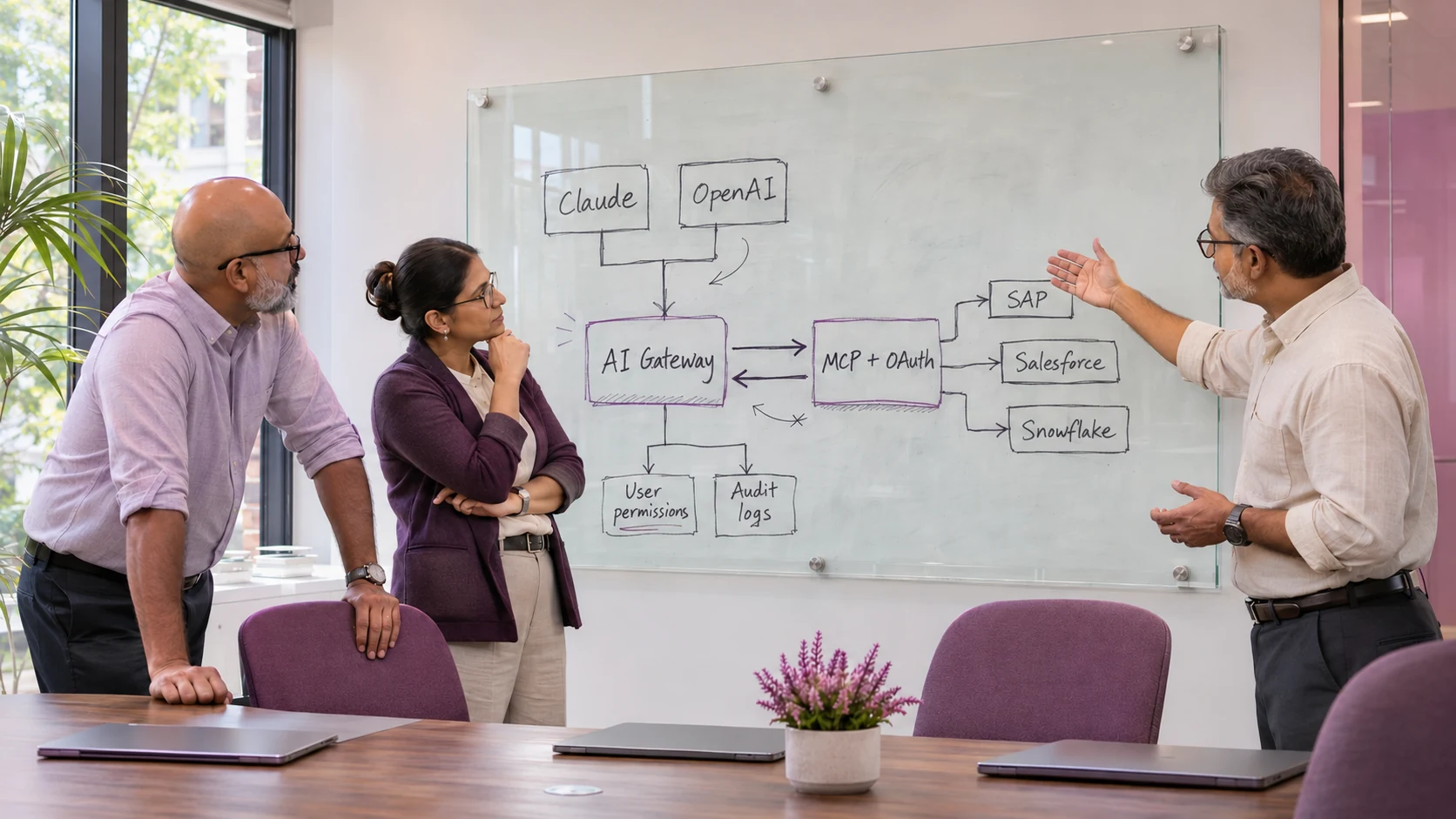
For AI initiatives, we identify the approved data, user permissions, evaluation requirements and integration points before selecting a model or agent framework. A proof of concept needs a route to production operations. Enterprise AI integration services can implement the connections after the architecture and service boundaries are agreed.
Architecture decisions include alternatives considered, trade-offs accepted and the circumstances that would justify revisiting them. That gives future teams a reasoned starting point instead of a diagram with no explanation of why the system was designed that way.
Turn priorities into an investment sequence
Elatre builds technology roadmaps that distinguish urgent operating work, enabling foundations and business capability improvements. Each initiative has an accountable owner, a defined outcome and the dependencies that must be resolved before delivery can start.
We assess the consequence of delay alongside the expected benefit of the change. An identity problem, a contract renewal and a revenue-facing feature do not share the same deadline or decision criteria. The roadmap explains those differences rather than compressing every request into one arbitrary priority score.
Financial planning includes implementation effort, platform costs, migration work, training and ongoing support. We separate recorded costs from assumptions that still need validation. Scenario comparisons help leadership understand what changes if a program is phased, postponed or reduced in scope. They also show which benefits depend on changes outside the technology team.
The FinOps Framework connects technology spending with business, engineering and finance responsibilities. In practical terms, we define cost ownership, allocation and review routines for the relevant platforms. A lower bill is not the only measure: the business also needs to understand what workload or capability the spending supports.
For leadership reporting, business intelligence consulting can implement an agreed view of program milestones, operating measures and investment decisions. The measures are defined with their owners, so program reporting does not become another collection of inconsistent spreadsheets.
Make the delivery and support model workable
Elatre defines the operating model around decision rights, team responsibilities and change controls. Digital transformation succeeds when business owners and technical teams can make decisions at the pace required by the work, with clear escalation when priorities conflict.
Business ownership and decision rights
Identify who owns each capability, approves process changes and accepts the delivered outcome. Record which decisions the delivery team can make and which require a sponsor. This prevents routine questions from waiting for a steering committee while significant changes are made without the right business owner involved.
Architecture and release governance
Define proportionate reviews for integrations, data changes, access and production releases. Reviews should produce decisions and actions, not an accumulating queue of documents. Teams need a practical route for exceptions, including who accepts the trade-off and when the decision will be reviewed.
Internal teams and delivery partners
Separate responsibilities across client staff, Elatre and software vendors. The plan identifies who provides business knowledge, controls environments, owns configuration and supports incidents. It also records dependencies between suppliers so an integration issue does not become an unresolved disagreement about whose contract covers it.
Adoption and ongoing operations
Plan training, communications, support ownership and the retirement of superseded processes. Users need to know how their work changes and where to get help. Operating teams need runbooks, access and monitoring before launch, rather than receiving those responsibilities after the project team has moved on.
How the strategy becomes an executable plan
Elatre delivers IT strategy consulting through a sequence of discovery, options analysis, roadmap design and implementation planning. The process keeps the sponsor involved in material choices and produces artifacts that can be used by internal teams or delivery partners.
1. Establish the decision and scope
Agree the business trigger, the systems in scope and the decisions the engagement must resolve. Review available architecture documents, contracts, performance reports and known issues. Identify the stakeholders whose input or approval is required, including the operational owners affected by the proposed change.
2. Assess options with the working teams
Validate the current-state picture and compare realistic alternatives. Examine interfaces, data readiness, operating requirements and organizational dependencies. Technical specialists and business owners review the options together so the recommendation accounts for actual workflows, not only product capabilities or architecture preferences.
3. Build the roadmap and business case
Sequence workstreams around dependencies, capacity and decision gates. Record the assumptions behind cost and benefit estimates, define acceptance measures and identify items requiring further discovery. Leadership receives choices with consequences, including what can be deferred and what must be addressed before implementation begins.
4. Prepare the first delivery workstream
Turn the selected priority into a usable brief, ownership model and acceptance plan. Define the next architecture decisions, required access and handover responsibilities. Elatre can continue into implementation under a separate scope, or prepare the package for the team and partners you choose.
Choose a scope that fits the decision
Elatre scopes digital transformation consulting around a defined portfolio, capability or investment decision. The engagement can focus on one business area or connect several programs when their dependencies need coordinated leadership.
A useful starting brief includes the business objective, current systems, proposed changes and the decisions that are stalled. Share existing roadmaps even if they conflict. We can use them to identify where assumptions differ and which questions need an owner.
Elatre works with organizations in the United States, United Kingdom, Canada, Switzerland, Germany and France. Regional systems, reporting calendars, access requirements and vendor contracts can be included in the assessment. The roadmap distinguishes shared global capabilities from differences that need a local implementation.
Our US desks are in New York, Houston and South San Francisco. Contact the team at +1 (346) 590-1999 to discuss the scope, the people who should join the first workshop and the materials that would make it useful.
| Engagement | Primary question | Typical decision package |
|---|---|---|
Technology portfolio assessment | Which systems and operating issues need attention first? | Current-state inventory, capability gaps, dependencies, risk priorities and options for the next stage. |
Target architecture and roadmap | How should the business capabilities and platforms fit together? | Architecture decisions, integration boundaries, sequenced workstreams and ownership model. |
Transformation program reset | Why is the current program struggling and what should change? | Scope review, dependency analysis, decision backlog and a revised delivery and governance plan. |
Implementation planning | How do we turn an approved direction into deliverable work? | Defined work packages, acceptance criteria, responsibilities, access needs and transition requirements. |
IT strategy consulting questions
Elatre answers IT strategy procurement questions through the decisions, deliverables and ownership included in the engagement. This helps leadership teams compare an advisory assessment with the additional work required to implement and operate a transformation.
IT strategy consulting connects business objectives to technology choices, investment priorities and an operating model. Elatre can assess the current estate, compare options, define target architecture and create an implementation roadmap. The scope identifies which decisions the engagement will resolve and the evidence needed to make them. Software implementation and ongoing operations are specified separately when they are required.
IT strategy determines which capabilities to invest in, how systems should fit together and how work should be sequenced and governed. Software development implements an agreed capability. Elatre can support both, but they have different deliverables and acceptance criteria. A strategy engagement can prepare a development brief without committing the organization to a particular build or platform before the options are reviewed.
Yes. We can examine the current scope, delivery dependencies, architecture decisions, supplier responsibilities and operating readiness. The review distinguishes delivery defects from unresolved business decisions or unrealistic assumptions. The output is a practical recovery or re-sequencing plan. Existing useful work is retained, and any recommendation to stop or replace a workstream is explained through its impact on the agreed business objective.
No. Elatre evaluates cloud, AI, platform replacement and targeted improvement against the business need. Some systems may remain where they are while surrounding integrations or processes improve. AI initiatives need suitable data, permissions, evaluation and operational ownership. The roadmap should explain where a technology is useful and where a simpler approach meets the requirement with less implementation work.
The agreed deliverables can include an estate inventory, capability and dependency maps, architecture decision records, options comparison, sequenced roadmap, responsibility model and implementation briefs. We define the level of detail during scoping. The handover explains remaining assumptions and decisions, giving your team a usable starting point for procurement, internal delivery or a subsequent Elatre implementation workstream.
Scope depends on the number of business areas, systems, stakeholder groups and decisions involved, along with the quality of existing information. Elatre reviews those factors before proposing milestones and fees. An assessment of one capability is different from a multinational portfolio review. The proposal separates consulting deliverables from implementation, software licenses and ongoing support so the commitment is clear.
Related services
Elatre connects it strategy consulting with the related engineering and business services below. Each engagement can define the interfaces and responsibilities between workstreams.
SAP Consulting and Implementation
Turn an approved ERP direction into process, integration and migration work.
Data Engineering and Lakehouse Consulting
Build the data foundations required by the roadmap.
Business Intelligence Consulting
Create consistent measures and decision reporting.
Enterprise AI Integration
Connect approved AI workflows to existing business systems.