United States · Shopify brands
Shopify SEO services for US brands
Get the search work done inside the store you already run.
Elatre helps Shopify merchants improve collections, product pages and the theme details that shape search discovery. We turn the audit into an implementation plan your merchandising, marketing and development teams can work from.
Collections · Product pages · Theme implementation

A store-specific approach
A useful audit should tell you where the change belongs
Some Shopify improvements belong in a collection’s content. Others belong in the theme, product data or an app’s configuration. Treating all of them as copy changes leaves important work unfinished.
We review a representative set of pages and identify the owner of each issue. Before editing a shared template, we check which products or collections depend on it. Before recommending another app, we look at the existing setup and whether it can already handle the requirement.
For a US storefront, the content should match the actual shopping experience: available products, displayed currency, shipping regions and return conditions. A global store may also need a market-specific review, but we do not assume that every merchant needs separate regional pages.
| Requirement | Likely working area | What needs review |
|---|---|---|
| Clearer collection positioning | Collection content and listing fields | Search intent and merchandise selection |
| Consistent product facts | Product data and page template | Accuracy and how the theme displays it |
| Repeated page elements | Theme sections or app output | Which templates inherit the change |
| Changed page addresses | Redirect and internal-link plan | Old URLs, new destinations and navigation |
What the engagement covers
A practical combination of content and store work
Collection search strategy
We decide which collections deserve attention based on customer demand, assortment and commercial priority. Overlapping collections need a clear reason to exist.
What you receive: A collection map with distinct page purposes and recommendations.
Product page guidance
We define the information needed for a purchase decision and how it should be presented across relevant product groups. Content must match the real product.
What you receive: Product content briefs and a repeatable specification structure.
Titles and descriptions
We write specific listing text for priority pages, then review how the theme outputs it. A saved field and a search engine’s displayed snippet are different things.
What you receive: Page-level metadata and checks on the rendered output.
Theme and app review
We inspect the page elements that affect usability and discoverability. The aim is to identify conflicting output and unnecessary complexity before proposing a change.
What you receive: A scoped list of theme or app actions with clear responsibility.
Navigation and page changes
We review collection links and plan for meaningful URL changes. A redesign should preserve useful routes through the store and account for existing destinations.
What you receive: Navigation recommendations and a redirect review where needed.
Validation and reporting
We check representative desktop and mobile pages after the agreed changes. Reporting follows the collections and products the project set out to improve.
What you receive: A change log, validation notes and a focused reporting plan.
The work can connect with Elatre’s broader ecommerce marketing services and website development. Any extra design, migration or app development work is identified in the proposal.
Worked example
Improve a work-bag collection without creating a second catalog
Suppose a Shopify brand sells work bags and a buyer searches for an everyday bag that fits a 15-inch laptop. The store has a broad “Bags” collection, but product capacity is difficult to compare.
Example collection brief: improve selection and product fit before creating more pages.
A product grid with little guidance
The customer must open several products to find dimensions, device fit, closure type and organization features. A new keyword in the title alone does not answer those questions.
Make the selection easier to judge
Verify which bags fit the intended device dimensions. Add a concise collection introduction, clear product facts and links to suitable alternatives where fit differs.
A dedicated laptop-bag collection may make sense if it offers a distinct selection and answers a real need. If the assortment is small, improve the existing collection first. We choose the structure based on the store rather than automatically creating a page for each phrase.
For the product template, the delivery team might approve a consistent specification block: external dimensions, internal compartment measurements, material and care instructions. Those verified facts can also support product comparisons in AI-assisted search.
An actual Shopify interface
Know what the listing editor can—and cannot—do
Shopify lets merchants edit search listing titles and descriptions. The screenshot below shows the collection editor in Shopify’s own guide. The fields are useful, but the collection content, selection and page experience still need to support the same promise.
Official Shopify interface example
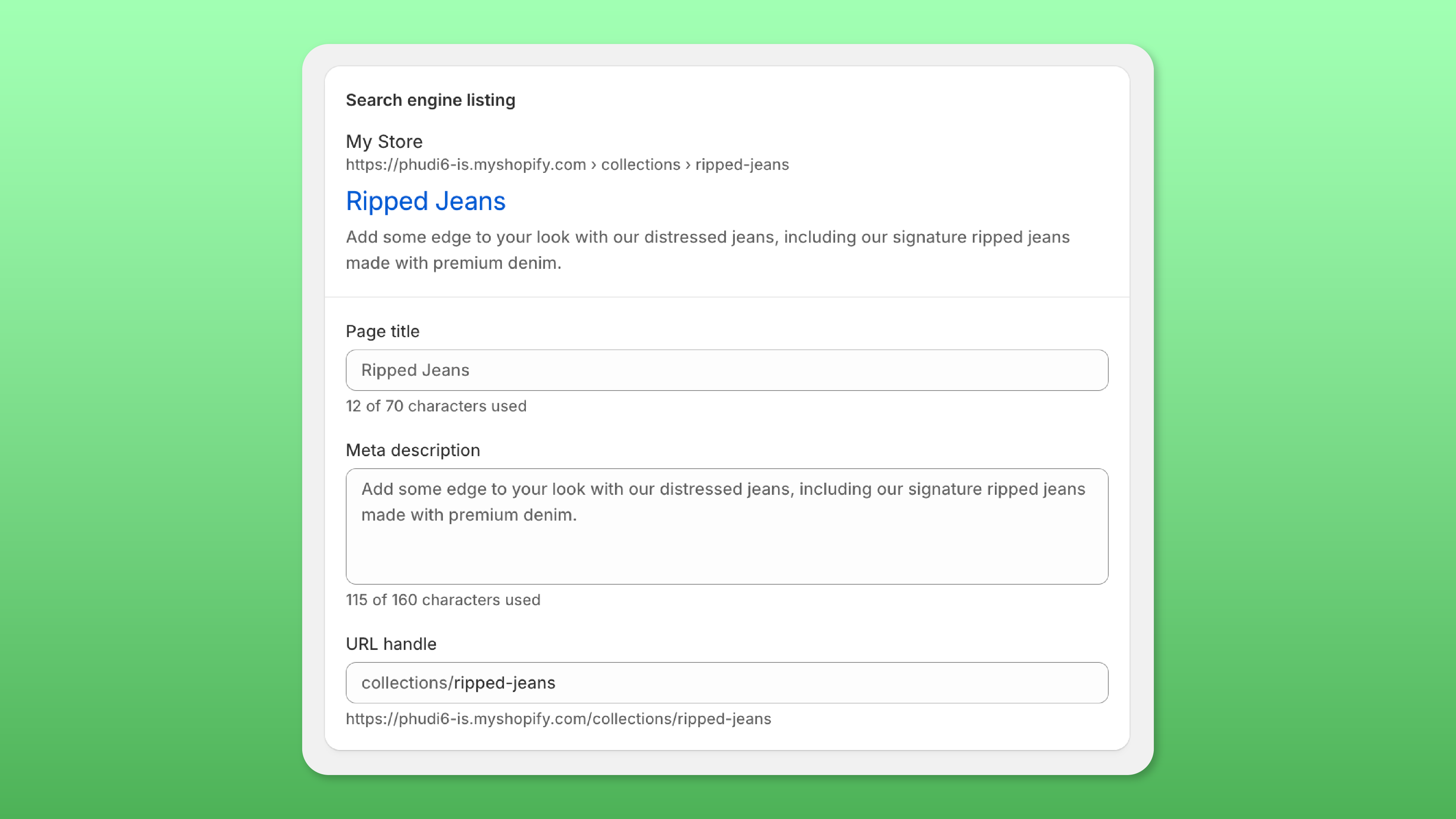
Shopify’s help documentation also explains descriptive image alt text and notes that search engines may display different titles or snippets. We write accurate text, verify the store’s output and avoid treating a preview as a guaranteed search appearance.
We keep image descriptions tied to what the photograph actually shows. A product shot needs useful visual detail; it does not need a list of every keyword you hope to rank for.
Implementation
Check the template before extending the change
We agree the collections, product groups and technical tasks in scope, then work through a small representative sample before expanding the change. That makes review manageable for your team.
- 01Review the storeUnderstand the theme, apps, collections and product structure.
- 02Choose a representative setInclude typical pages and relevant edge cases, such as variants.
- 03Implement and inspectCheck content, links and page behavior on desktop and mobile.
- 04Extend the approved workApply the pattern where appropriate and record what changed.
For shared theme work, the release process is agreed with your team. If a URL changes, its old address and relevant internal links belong in the same task. If an app owns a piece of output, we review that setting before adding another implementation.
Google’s ecommerce structure guidance supports clear links from categories to products. We use that principle to review navigation instead of assuming that products reachable only through store search are easy for crawlers to discover.
Our AI SEO and GEO service can extend the project to broader answer visibility. The Shopify work remains grounded in accurate store information and a usable shopping journey.
Before a theme change goes live
Check a representative shopping journey
A template can look correct on one product and still fail on another. We include the relevant edge cases in the review: a long product title, multiple options, an unavailable variant and the priority collections.
| Page area | Check before release |
|---|---|
| Collection | Title, description, product links and useful sorting or filtering |
| Product | Images, verified specifications, options and current availability |
| Mobile interaction | Readable text, usable option controls and a clear purchase action |
| Page addresses | Intended destinations, redirects where needed and updated internal links |
The release note records the templates changed, pages checked, remaining issues and who approved the work. That gives your team a useful reference when the next theme or app update happens.
Measurement
Track a collection change as a collection change
A store-wide traffic number can hide whether the pages you improved are doing their job.
| Area | What to compare | What to note |
|---|---|---|
| Priority collection | Relevant search visibility and landing visits | Content, navigation or assortment changes |
| Product group | Product views and available purchase data | Stock, variant availability and promotions |
| Mobile journey | Use of filters, options and next steps | Theme releases and app changes |
| Implementation | Completed changes and remaining issues | Ownership, review date and dependencies |
We establish a baseline before implementation and record the release date. A sale, new product launch or change in inventory can affect performance alongside SEO. Reports should show those events rather than attributing every movement to a title edit.
For AI-assisted discovery, we can monitor an agreed set of product and category questions. Observed mentions, cited pages, identifiable referral visits and purchases remain separate measures. None is a substitute for checking that the store’s product facts are correct.
Questions before you start
Practical answers
Do we need an SEO app before starting?
Not necessarily. We first review the store’s existing features, theme and apps. An app is useful when it solves a specific requirement cleanly; adding one without that requirement can create more settings and overlapping output to manage.
Will you change our theme?
We may recommend focused theme changes when content alone cannot resolve an issue. The proposal identifies the work and review process. A full redesign is a separate decision, not an assumed part of every Shopify SEO project.
Can you improve collections without changing their URLs?
Often, yes. Content, navigation and metadata can be improved without a URL change. When a new address is justified, we include redirects and internal-link updates in the implementation plan.
How much text should a collection page have?
Enough to help the shopper understand the selection and make a decision. A useful introduction and concise buying guidance are often more helpful than a long generic passage. We do not use a fixed word count as a ranking formula.
Can you help before a migration or redesign?
Yes. Share the planned changes early so the scope can include page mapping, content ownership, redirects and checks on representative pages. Migration support is priced around the size and complexity of the move.
Can you guarantee rankings or AI product recommendations?
No. Shopify improvements can make the store easier to use and its information easier to access. Search platforms still decide what to rank, cite or recommend. We report the changes and the outcomes that can actually be observed.
What access will the project need?
We agree the store permissions required for the work in scope, plus available search and analytics reporting. Your team confirms product facts, policies and approval of changes. Send the store URL and priority collections to begin scoping.
Build a Shopify SEO strategy around products people can buy
A Shopify SEO agency needs to understand the catalog, theme and buying journey together. We connect technical search engine optimization with collection structure, product information and content marketing. Our SEO strategy prioritizes high intent searches that match available products, then checks whether the landing page helps customers compare and choose. Our conversion rate optimization services test product pages and checkout so more of that traffic becomes sales.
Organic search should work with the rest of your digital marketing. We use data driven reporting to connect product discovery, traffic and sales, while separating ranking movement from changes in inventory, promotions or demand. Link building supports useful pages and relevant relationships rather than a fixed monthly link count. When comparing a Shopify SEO company, ask who will implement theme changes, review redirects and check that new content fits your product range.
Our seo migration services connect Shopify URL mapping, staging checks and post-launch monitoring.
Make the next step useful
Give your Shopify store a clear search work plan
Send us your store URL, theme and priority collections. Tell us about any upcoming redesign, app change or migration so we can plan around the work already underway.
Plan the work around your Shopify store
For catalog strategy beyond one platform, explore ecommerce SEO services. If the project also needs paid campaigns, creative or retention, see our ecommerce marketing services.
Read our Shopify brand growth case study for an example of a broader marketing engagement. The project combines channels; its results should not be treated as an SEO-only outcome.