BUILD THE FIRST USEFUL VERSION
AI MVP development services for ideas worth testing
Put a working AI product in front of users and learn what deserves your next investment.
Elatre provides AI MVP development services that turn a defined problem into a working first release. We help you choose the essential features and build an AI minimum viable product around a clear test. The work connects product design, software development and model evaluation, so you can judge the experience, the quality of the answers and the cost of running it.
For founders, B2B software companies and enterprise product teams.
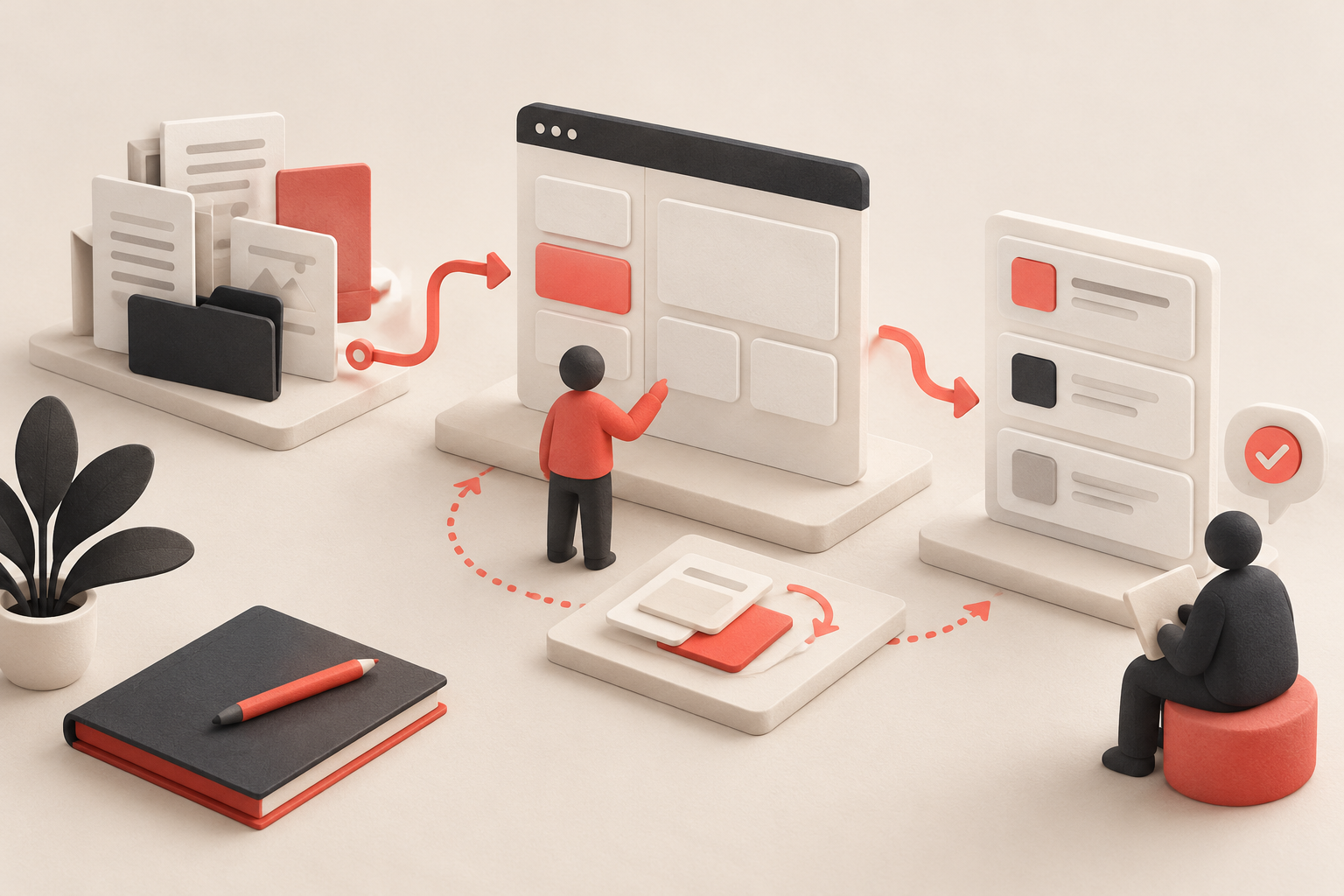
Build the first release around a task users can complete and a result your team can evaluate.
START WITH A DECISION
Your first release should answer a business question
An impressive demonstration is useful, but it does not tell you whether customers will return, whether staff will trust the output or whether the numbers work at scale. An AI MVP gives a defined group of users enough of the real experience to test those questions. The first decision is what you need to learn, not how many features can fit into a launch.
We begin with the person using the product, the task they need to complete and the current way of doing it. We then identify where AI helps and where ordinary software is more dependable. A reliable search, a clear form or a rules-based workflow may solve part of the problem without another model call. That choice can make the product easier to use and less expensive to operate.
Our software development services connect the interface, application logic, integrations and AI behavior. When the pilot establishes what works, generative AI development can extend the product into a broader implementation. The next stage follows evidence from the first release rather than a list of features chosen before anyone used it.
Consider a B2B sales team that receives product questions in several formats. Its business goal might be to prepare a usable response without making a customer wait for information that already exists. An AI powered pilot could find approved product details, draft an answer and show the source to a salesperson. Testing that journey with real world enquiries reveals more than demonstrating a polished answer to a sample prompt. Does it recognise an outdated specification? Does it stop when a price needs approval? Does the salesperson spend less time checking the draft than writing the answer? Those questions turn market demands into useful acceptance criteria.
Data security belongs in the first release. We identify what information the pilot needs, who may access it and which external providers receive it. With AI integrated into an existing application, permissions should follow the user through the whole task: a search feature must not reveal a document the user cannot otherwise open. The AI MVP development process also distinguishes model training from using an existing model with approved information. Machine learning based on your own examples may be appropriate for some tasks, but training a new model is not a requirement for every pilot. We explain the tradeoff before adding that cost and maintenance work.
When comparing an MVP development company, ask what evidence will support the next investment. AI MVPs should leave you with a clear account of user behaviour, useful outputs, failures and operating costs. A full scale product may need more capacity, broader support, additional permissions or integrations that the pilot deliberately excluded. We record those gaps so early shortcuts do not become invisible obligations. Planning for the long term means knowing which parts can be extended, which need replacement and what has actually been validated before committing to a larger release.
One priority workflow
A measurable standard
A practical next decision
WHAT WE CAN BUILD
AI MVP development from scope to a working pilot
The proposal names the workflows, users and outputs included. We choose the smallest scope that can produce a useful answer about the product.
Product discovery and feasibility
Output: An agreed first-release scope, assumptions and criteria for evaluating the pilot.
A usable application
Output: A working interface connected to the agreed product workflow.
AI and knowledge integration
Output: The agreed AI capability, connected to relevant data and application rules.
Evaluation and failure handling
Output: Evaluation cases, recorded results and visible handling for known failure modes.
Essential system connections
Output: Documented connections with agreed permissions, checks and error handling.
Pilot visibility and handover
Output: A pilot release, operational notes and an evidence-based next-release plan.
WHERE AN MVP HELPS
A first product for different kinds of decisions
The right MVP depends on who will use it and what a successful test would allow your business to do next.
Founders testing a new product
Software teams adding AI
Enterprises testing an internal tool
HOW WE WORK
From an idea to evidence you can act on
Each stage ends with a decision or a usable output. Product owners and subject experts stay involved where their judgment matters.
01 · Define what the pilot must prove
02 · Build and review working increments
03 · Evaluate before inviting users
04 · Run the pilot and choose the next step
MAKE THE RESULT USEFUL
Evidence, ownership and operating costs belong in the handover
Our Atlanta logistics AI case study shows how an AI workflow can connect to the systems people already use. Elatre connected four operating systems, automated routine dispatch communication and routed exceptions to staff. The published case reports combined dispatch administration falling from 14 hours to under two hours a day over six months.
NIST's AI risk management guidance describes repeatable evaluation and ongoing monitoring. In a pilot, that means keeping the test cases and results alongside the product, so a future change can be judged against the same standard. AI cost optimization can then examine model usage, context and workflow design when operating costs become a constraint.
A transparent scope and budget
Clear access and ownership
A launch with a purpose
BEFORE WE START
Questions about AI MVP development
Practical answers about planning, delivery and working together.
A proof of concept tests a technical question, such as whether a model can extract the information you need from a document. A prototype explores the interaction. An MVP combines enough of the real product for intended users to complete a useful task. We choose the starting point based on the uncertainty you need to resolve.
Yes. We compare the proposed AI capability with the current process and simpler approaches. The question is whether AI adds enough value to justify its variability, running cost and maintenance. Some products benefit from a small AI feature inside an otherwise conventional application. Others need a feasibility test before a product build makes sense.
Bring a description of the user and task, examples of the inputs and desired outputs, and details of the systems involved. A product owner and someone who understands the subject matter should be available for decisions. If data access or quality is unresolved, we identify that dependency before committing to a development schedule.
The main factors are the number of workflows, data preparation, integrations, access controls and evaluation requirements. A focused pilot with available data differs substantially from a multi-role product connected to several enterprise systems. After discovery, we provide a scope, estimate, milestones and the assumptions that could affect delivery. We also discuss expected ongoing cloud and model costs.
Ownership, account access and third-party dependencies are set out in the agreement. The handover should identify the source code, deployment configuration, documentation and evaluation materials you receive. Model services, licensed components and cloud accounts have their own terms, so we make those dependencies visible before they become part of the product.
Yes, where the pilot evidence supports further investment. The next phase may add capacity, more workflows, stronger operational controls or deeper integrations. Some early components may need revision once actual usage is understood. We provide a roadmap based on those findings rather than promising that every first-release decision will remain suitable at every scale.
CONNECTED SERVICES
Related services
LET’S TALK
What does your first AI product need to prove?
Share the user problem, the workflow you have in mind and any sample data or existing product. We will help define a useful first release and the evidence you need before committing to a larger build.