
Mathematician Levent Alpöge has posted a four-page note saying he believes he found a proof of the Riemann hypothesis while working with Claude. He says the argument has been formalized and links to the files. The note establishes what Alpöge is announcing. Whether the argument establishes the theorem is a separate question that mathematicians can now examine. Read Alpöge’s original note (PDF) Clay Mathematics Institute problem statement
Three different mathematical claims
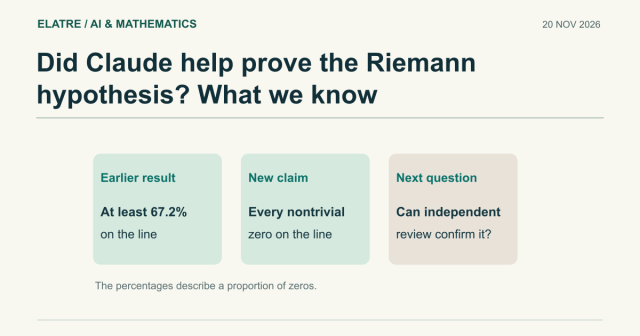
What would a proof actually establish?
Prime numbers are numbers greater than one with no positive divisors except one and themselves. Their distribution has structure even though the gaps between individual primes vary. The Riemann zeta function is one way of studying that structure. The hypothesis says that every nontrivial zero of this function has real part one-half. In a plot of complex numbers, that puts all those zeros on one vertical line. Clay Mathematics Institute problem statement
The word “every” is doing the hard work. Check a million cases and a critic can still ask about the next one. Prove a result for a very large fraction and the remaining fraction is still an open question. A full proof must provide reasoning that rules out every exception. That is what makes the November claim more ambitious than an earlier result associated with Claude. Clay Mathematics Institute problem statement Anthropic’s earlier result
Why this differs from Anthropic’s earlier report
In an earlier project, Anthropic reported raising a lower bound on the proportion of zeros on the critical line from 41.6% to 67.2%. That is a statement about how large a fraction must lie on the line. It does not assign a 67.2% probability to the hypothesis or mean that 67.2% of a complete proof has been finished. Alpöge’s new note makes a claim about all of the relevant zeros. Anthropic’s earlier result Read Alpöge’s original note (PDF)
A formalization is another part of the story. A computer can check an argument expressed in the language of a proof assistant against its assumptions. A reviewer still needs to establish that the statement represented there is the intended mathematical theorem, and that the supplied work and its dependencies support the result being announced. Alpöge’s note points to the formal materials and describes his intention to explain the argument in greater detail. Read Alpöge’s original note (PDF)
What would count as independent confirmation?
Look for work from mathematicians who examine the theorem statement, assumptions and reasoning directly. An account that simply repeats the original note adds reach without adding verification. Clay Mathematics Institute has a separate formal prize process, including a qualifying publication, a minimum two-year interval after publication and general acceptance in the mathematical community. That timetable is about the prize. Technical scrutiny can start as soon as other researchers have material to study. Clay Mathematics Institute prize rules
As of November 20, the accurate headline is that a mathematician has announced an AI-assisted proof and made materials available for examination. The important author, verb and object all fit in that sentence. There is no need to convert the announcement into a verdict before the verification arrives.
For teams evaluating model-generated answers at work, Elatre’s guide to LLM evaluation explains how to build a test set and compare a system’s answers with independent evidence.