
A design engineer changes the hinge on a laboratory enclosure. The replacement uses the same mounting holes and fits the same drawing outline. It arrives with a different fastener and the plant has 80 of the old hinges in stock. Which enclosure gets the new part first? Every product lifecycle management proposal looks more concrete once the vendor has to answer that question on screen.
Product lifecycle management (PLM) connects product definitions, revisions and approvals over time. For a manufacturer, one of its most valuable jobs is making sure an approved design change reaches the people who buy parts, write work instructions and assemble units. Here is a buying test production and engineering can run together.
Start with the last unit of the old design
Give each vendor the same test pack. Include a released drawing for hinge revision B, a proposed revision C, the two fastener numbers, a short assembly list and an open purchase order for B. Tell them that units through serial number 820 must use B. Unit 821 is the first to use C. That boundary is the change’s effectivity, meaning where or when the change applies. A drawing release date alone cannot tell an assembler which hinge belongs on a partly built unit.
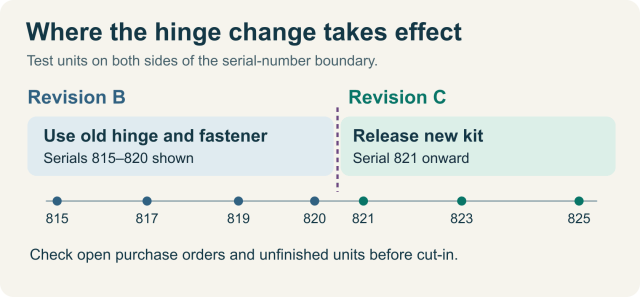
Ask engineering to open one change request. The record should state why the hinge changed, which assemblies use it and who can approve the new design. Then ask the vendor to retrieve the old drawing. A service technician may still need it to repair a unit built months earlier. Preserving that history is part of the purchase decision.
Follow the change into a real work instruction
An engineering bill of materials describes the design. A manufacturing bill of materials describes how a particular plant plans to build it. A plant may group parts into kits, add a consumable or arrange an assembly around its production sequence. PTC’s documentation describes how an engineering bill can be transformed into a manufacturing bill while retaining the relationship between them. PTC’s engineering-to-manufacturing BOM guide.
For the hinge test, ask the manufacturing engineer to open the fastener kit for unit 821. It should contain the new fastener and link to the revised instruction. Now open a work order for unit 819 that was issued before the change and remains unfinished. Its material list and instructions should agree with the rule for B. If the system displays the newest attachment for both units, capture that result. The unresolved work belongs in the implementation budget.
Find the person who can release the purchase order
Give purchasing one open order for 100 old hinges. A useful workflow shows the affected order and allows the buyer to record an agreed decision. The customer may choose to cancel part of the order, reserve stock for repairs or run down the old inventory under an approved exception. There is no universal answer. The test is whether purchasing can see the change, act before goods arrive and preserve the decision beside the order.
Next, temporarily pause the test ERP connection and release the engineering change. The plant should be able to see the difference between an approved change and one received by ERP. When the connection resumes, have the vendor demonstrate a retry. Check that the part revision arrives exactly once and that a planner can tell which system still needs attention if the handoff fails.
Ask for four pieces of evidence
- The approved change record, including the person who set the serial-number boundary.
- The parts and instructions applicable to units 819 and 821, captured from the plant’s view.
- The purchasing decision against the outstanding order and the owner of the 80 hinges in inventory.
- The downstream receipt or exception, with a timestamp that the planner can interpret.
A vendor who can provide all four has demonstrated a full business transaction. A missing item points to a specific integration, approval or training cost. Score the same change with each vendor, then use the gaps to define the first plant’s pilot. Elatre’s PLM consulting and CAD-to-ERP integration services.
For a shortlist discussion, use our PLM consulting company comparison alongside the engineering-change test.