
Your paid-search report shows that Campaign A brings in inquiries for $50 each. Campaign B costs $100 per inquiry. Moving the next dollar to A seems obvious. Then sales opens the CRM and shows you that the cheaper campaign produced fewer qualified opportunities. Before you approve the budget change, ask which business outcome the report priced.
For a lead-generation business, a useful PPC management scorecard connects campaign spend to a sales stage that people apply consistently. Cost per qualified lead is ad spend divided by the number of qualified leads attributed to the same group of clicks. The calculation is simple. Agreeing which leads belong in that group takes more care.
Count one month of prospects the same way
Here is an illustrative example for a commercial cleaning company. It qualifies a lead once a prospect requests a recurring commercial contract within its service area and sales confirms a suitable contact. A job applicant, a duplicate form and a request for a one-off home cleaning stay out of that count. The example uses ad spend only. Add management fees separately if you also report a fully loaded acquisition cost.
| Measure | Campaign A | Campaign B |
|---|---|---|
| Ad spend | $6,000 | $4,000 |
| Unique inquiries | 120 | 40 |
| Qualified leads | 12 | 16 |
| Cost per inquiry | $50 | $100 |
| Cost per qualified lead | $500 | $250 |
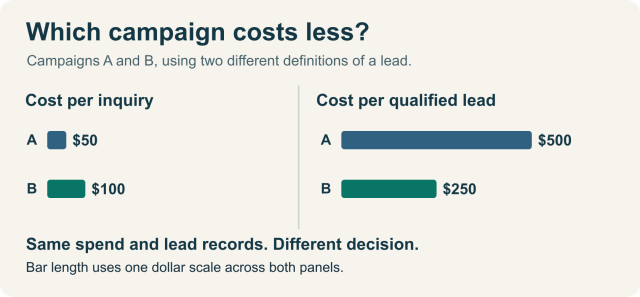
Campaign B is twice as expensive per inquiry and half as expensive per qualified lead. Its inquiries qualify at 40%, compared with 10% for A. That earns B a budget test. It still leaves open whether the extra traffic will have the same quality, how many qualified prospects will buy and how much their contracts are worth. As deals close, add a won-contract column and compare contribution from those contracts with the full acquisition cost.
Track what sales actually means by qualified
Write one sentence that the sales team can apply to an individual call. For the cleaning company, that sentence names the service type, geography and required contact. Add a timestamp when sales first reaches the stage. Keep a reason for a rejected inquiry and a separate status for a prospect awaiting a callback. Without that distinction, a short-staffed sales desk can make good campaigns look expensive.
Google Ads supports separate goals for qualified and converted leads. A team can use its CRM-defined milestone when reporting later funnel outcomes back to Ads. Choose the event that matches the business decision, confirm the same milestone means the same thing across teams and follow Google’s customer-data requirements when connecting the systems. Google’s guide to qualified and converted leads.
Use an equal window before judging results
Suppose sales needs up to ten business days to qualify a lead. A lead received on the last Friday of the month has had less time to progress than one received on the first Monday. Group prospects by the week of the originating inquiry, keep their eventual qualification attached to that group and compare groups that have had the same time to mature. Report recent groups separately as provisional.
Reconcile a small sample before you change bids. Trace one submitted form, one phone inquiry, one duplicated inquiry and one rejected lead from the original campaign to the final CRM record. Record which source or campaign values survived. A prospect who submitted twice should count once under a defined rule. Keep unmatched leads visible as a separate count until the team can explain the gap. Silent exclusions can make an apparently precise cost figure unreliable.
Turn the scorecard into one budget decision
Start the review with the campaign showing the largest gap between inquiry cost and qualification cost. Inspect the search terms, promise in the ad, landing-page offer and rejection reasons together. If A attracts residential customers because its page says only “schedule a cleaning,” change the promise and lead form before dismissing the channel. If B repeatedly qualifies business contracts, increase spend in a measured step and watch the next mature group. Record what would justify keeping or reversing that change.
A good monthly review ends with a named owner, one adjustment and the date the team will have mature results. It also gives sales a reason to keep the CRM stages accurate. Elatre’s paid ads and PPC management services.
When ads, analytics and the CRM disagree about which leads converted, our marketing analytics service covers the reconciliation work.