
Two buyers enter the same supplier under slightly different names. Accounts payable also keeps a record for the supplier’s repair depot. A cleanup project merges all three into one address. The next return goes to headquarters, where nobody accepts deliveries. The duplicate count falls and the operational problem gets worse.
Master data management (MDM) gives teams a governed way to identify shared business entities, connect their source records and decide which attributes downstream systems should use. A supplier example makes the quality of those decisions visible early in a buying process. Give every vendor the same four invented records and ask a procurement colleague to judge the result. IBM’s introduction to master data management.
Bring four records to the demonstration
| ID and source | Input | Known context |
|---|---|---|
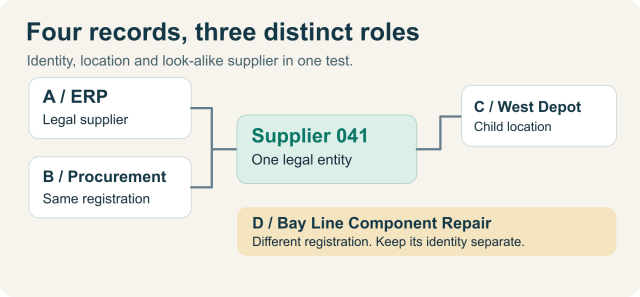
| A · ERP | Bayline Components LLC | Verified legal entity, supplier 041 |
| B · Procurement | Bayline Components | Same verified registration as A |
| C · Depot directory | Bayline Components, West Depot | Returns site belonging to supplier 041 |
| D · CRM | Bay Line Component Repair | Separate verified registration, similar name |
A and B describe the same legal entity in this example. C describes a place where work happens. D belongs to a different business. A good demonstration preserves those distinctions and shows how the system reached each decision. Ask the vendor to run the exercise once with the registration evidence and again with that field removed from B. The second run should reveal how an uncertain match reaches someone with authority to resolve it.
Write the rules for individual fields
“The ERP wins” is a tempting rule until procurement fixes an obsolete returns address and the next synchronization restores the old value. Give ownership to the team that has authority over the field. Accounts payable might own payment terms, procurement might own supplier approval and a depot manager might own delivery hours. A record can contain values from each of these sources.
Ask the vendor to change Tuesday receiving hours in the depot directory. Have them show the source value, the resulting master value, the time of the change and the copy delivered to the purchasing system. Repeat the test with an empty address on an incoming file. Decide in advance whether an empty field means missing information or an instruction to erase a value. Those are different business actions and require different rules.
Time the correction you hope never to make
For the final test, deliberately approve a mistaken link between A and D in the demonstration environment. Have a steward notice the error, separate the entities and identify impacted systems. Record the identifiers before and after the correction. A reviewer should be able to tell which orders need follow-up, which users approved the change and which systems still hold an outdated link. If a correction requires engineering help, include that team in the estimate.
Measure the result using a set that people have already labeled. Suppose the trial proposes 50 automatic matches and a steward confirms 48. Its observed precision on that set is 96%. To measure the matches it missed, the team also needs the number of true duplicates in the full test set. If there were 60 true duplicate pairs and it found 48 of them, recall is 80%. Neither percentage says how a future supplier population will behave. Keep name formats, subsidiaries and shared addresses represented when you enlarge the sample.
Decide what earns a pilot
Ask purchasing, finance and operations to mark the outputs separately. Can a buyer find one approved supplier? Can finance trace terms to the right legal entity? Can the depot receive a return at the correct address? Keep incorrect merges, missed duplicates and unresolved exceptions in separate columns. The first may lead to payment errors, while the last tells you how much steward time the pilot needs.
A short, repeatable test gives a vendor something specific to implement and gives procurement a clear basis for comparing proposals. Bring the four records, the expected hierarchy and one example field with disputed ownership to the scoping meeting. Elatre’s master data management implementation services.
Where procurement and finance use separate applications, the MDM and PIM implementation partner comparison gives buyers more questions to put to a shortlist.