
The earthquake that woke people around Los Angeles on Friday, November 20, struck just northwest of Commerce at 3:25 a.m. Pacific. The reviewed US Geological Survey record gives it a magnitude of 4.2 and a depth of about 15.5 kilometers, or 9.6 miles. If you are comparing alerts, look for event code ci41364111. That code follows this earthquake even when the figures change. USGS reviewed event
The reviewed USGS record
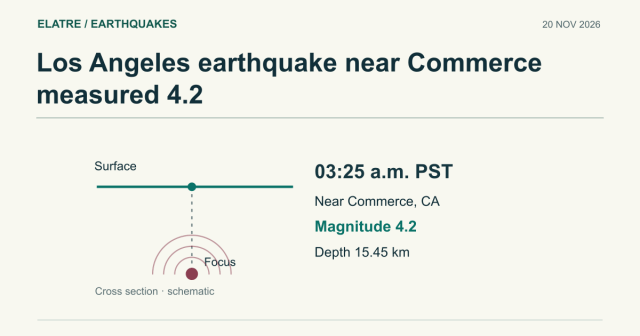
| Field | Reviewed value |
|---|---|
| Local time | November 20, 2026 at 3:25 a.m. PST |
| Magnitude | 4.2 |
| Depth | 15.45 km |
Why did the first alerts say 4.4?
An early Southern California Seismic Network map listed 4.4. The reviewed federal event record available at 7:23 a.m. Pacific listed 4.2. Both refer to the shock at the same time near Commerce. A text message or a screenshot made in the first minutes can remain in circulation for hours after scientists update the source. Early Caltech and USGS regional map USGS reviewed event How USGS revises magnitudes
Seismic instruments at different distances detect the waves at different times. The first calculation may use a small number of nearby instruments. More readings give scientists an opportunity to refine both where the quake began and how large it was. When comparing two reports, read the event time, event ID and review status before comparing the decimal. How USGS revises magnitudes
Was the shaking stronger in my neighborhood?
Magnitude describes the size of an earthquake at its source. The shaking in a particular home is a different measurement. For a picture of that variation, open the event’s “Did You Feel It?” report. USGS collects people’s observations and maps the intensity reported by location. A person upstairs, a person on the street and someone farther away can describe the same earthquake differently. USGS Did You Feel It?
If you felt it, fill out the USGS questionnaire with what you observed at the place you were at the time. If another person saw a shelf move somewhere else, that observation belongs to their location. The map is most useful when each report describes one person’s own experience. USGS Did You Feel It?
How to share an update that stays useful
Send the live event page when checking in with family or colleagues. Include the time zone if they live outside California. If you are updating a community website, keep the original event time beside the magnitude and give the revision its own timestamp. Someone comparing your update with a phone alert can then see what changed without having to guess whether a second earthquake occurred. USGS reviewed event