
A warehouse team needs label-printing software at six packing stations. Its existing application runs on a server due for replacement. One proposal moves the server to the cloud. A second rebuilds the print service on a managed platform. A third replaces it with a shipping subscription. Each could carry the description “cloud computing services.” Only one of the three proposals prices the work of maintaining the old application.
The quickest way to narrow a cloud shortlist is to choose one workload, identify what you need to control and ask who will carry the pager when that workload stops. Those answers make the price comparison much more useful.
Which cloud service model fits the work?
With software as a service (SaaS), you buy access to an application. Platform as a service (PaaS) lets you deploy your application on a provider-managed runtime. Infrastructure as a service (IaaS) gives your team control of virtual machines and their guest operating systems. These are the three service models in the standard NIST definition. NIST’s definition of cloud computing.
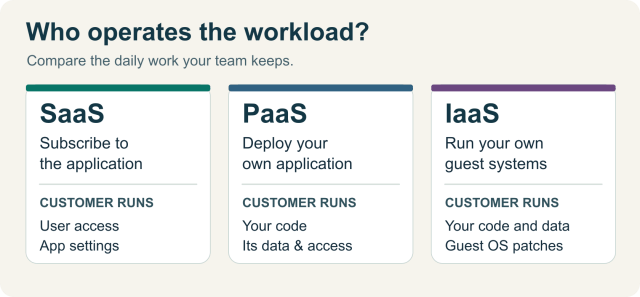
Start with the least complicated option that meets the operating requirement. For the warehouse, a SaaS trial is worthwhile if the product supports the carrier, printer model and packing workflow. Ask a packer to print a replacement label after a damaged shipment. That one action tests a real exception that a standard sales demo can easily miss.
A managed platform earns a closer look when the application contains business-specific logic a subscription cannot reproduce. Ask the platform team to deploy a small version and connect it to an actual test printer. A VM may be the practical choice if the legacy application needs a particular operating system or print driver. In that case, the proposal needs an owner for guest patching and a plan for the application when the driver reaches end of support.
Price a completed job
A provider quote usually names the resources it sells. Finance needs a figure that includes the work the company keeps. For the warehouse, a useful unit is the cost of producing a usable label. Set a monthly volume first, then include people’s time, support, data transfer, storage and any integration or licensing fees that differ between options.
Suppose a managed option costs $2,400 per month and takes eight hours of internal support at $75 per hour. A VM option costs $1,450 and takes 24 hours at the same rate. At 15,000 usable labels, the managed option comes to $3,000, or 20 cents per label. The VM comes to $3,250, or about 22 cents. These are invented figures for the exercise. The VM’s infrastructure bill is lower and its total operating cost in this example is higher.
Now add the one-time move. If the managed option costs an extra $18,000 to implement, the $250 monthly saving takes 72 months to recover at that volume. A three-year contract could easily end before then. Ask for a second calculation at peak volume and ask what happens to the unit price when use falls. Flat subscriptions, metered operations and reserved capacity behave differently.
Run one test the contract will have to survive
Choose one foreseeable interruption and agree on the required outcome. For example, when the connection resumes after a short outage, a pending shipment should produce exactly one live label and a usable tracking entry. Give the team test orders with location and time stamps. Record which printed, which entered a retry queue, and what a packer could see during recovery. A successful test produces evidence that the team can repeat after a software update.
Put three names beside the result. Who takes the first call from a packing station? Who can restore service? Who can reconcile a shipment billed twice? If the provider owns only one step, request an introduction to the person responsible for the next. The most consequential gap can be the ten minutes both parties spend waiting for the other to act.
End the decision with a single page that records the workload, selected model, full cost per unit, recovery result and named operating owner. If you need an implementation estimate, those five items give an engineer enough context to scope the work. Elatre’s cloud implementation services.
A workload that holds customer or payment data also needs an owner for access and recovery. Elatre’s cloud security service explains how to review those responsibilities before migration.