
Imagine building a beautiful website, only to find it lost in the vast ocean of the internet, barely visible to potential visitors. Frustrating, right? This is precisely what happens when your website’s SERP ranking is low. But what if I told you that increasing your SERP ranking is more manageable than it seems? With the right strategies, you can elevate your website’s position and ensure it’s visible to your target audience. So, how do you rise above the competition and secure a top spot on search engine result pages? Let’s dive into some practical strategies.
Understanding SERP Ranking and Its Importance
Search Engine Result Page (SERP) ranking is your website’s position on search engines like Google when users search for relevant keywords. A higher SERP ranking means your website appears closer to the top, increasing its visibility and the likelihood of attracting organic traffic. But why is this important?
- Increased Visibility: Websites that rank higher on SERPs are more likely to be clicked on by users. This leads to higher traffic and more opportunities for conversions.
- Credibility and Trust: Users often associate top-ranking websites with credibility and trustworthiness. A higher SERP ranking can enhance your brand’s reputation.
- Competitive Edge: A high search engine optimization rating can help you stand out in a crowded industry and keep your company in the minds of potential clients.
Optimize Content for Better SERP Ranking
Search engine results page (SERP) improvement is essential for improved rankings. This involves making your website’s content more relevant, engaging, and aligned with what search engines look for.
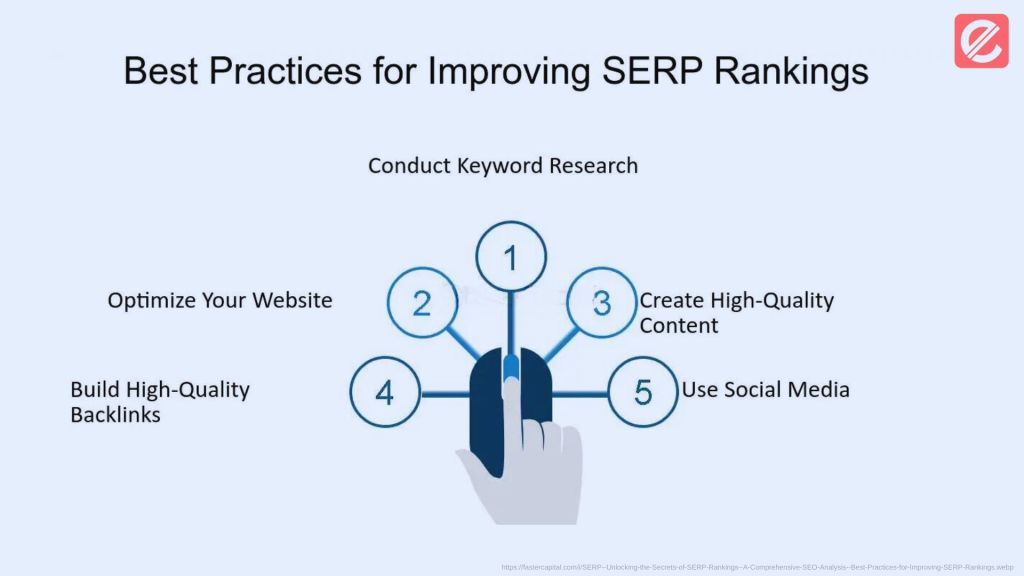
- Keyword Research: The first step is to find out what your ideal customers are looking for online. Use tools like Ahrefs or Google’s Keyword Planner to identify low-competition, highly relevant keywords. Use these keywords consistently across your material, from headings to body text to titles.
- Quality Content: Search engines prioritize high-quality content that provides value to readers. Make it a priority to write fresh, in-depth articles that answer your readers’ questions and concerns.
- On-Page SEO: Verify that on-page SEO elements are being utilized to optimize your content. This includes using meta tags, alt tags for images, and internal linking. Ensure your content is structured with H1, H2, and H3 tags to improve readability and SEO.
Improve Website Speed for Higher SERP Ranking
Web page loading time directly correlates to a site’s position in SERPs. A slow-loading website can frustrate users, leading to high bounce rates and lower rankings.
- Optimize Images: Page loads may be affected by the size of your images. Images can be compressed and saved in the correct format to make page loads faster.
- Minimize HTTP Requests: The more elements your page has, the more HTTP requests are made, which can slow down your site. Simplify your design by reducing the number of elements on your pages.
- Use Browser Caching: Browser caching stores some of your website’s data on a visitor’s browser, reducing the time it takes to load your site on subsequent visits.
Leverage Backlinks to Boost Your SERP Ranking
Backlinks are links from other websites to your site. They act as votes of confidence and can significantly impact your SERP ranking.
- Guest Blogging: Contribute high-quality guest posts to reputable websites in your industry. Ensure that these posts include links back to your website.
- Build Relationships: Connect with influencers, bloggers, and industry leaders who might link to your content. Building solid relationships in your niche can lead to valuable backlinks.
- Create Link-Worthy Content: External links are more likely to appear in educational, original, and aesthetically delightful content. Infographics, research studies, and in-depth guides are great examples of link-worthy content.
Enhance User Experience for Better SERP Ranking
In search engine results page (SERP) ranking, user experience (UX) is significant. Search engines like Google consider how users interact with your site when determining rankings.
- Mobile Optimization: Now that mobile devices account for the vast majority of website traffic, optimizing your site for this medium is crucial. You must have a responsive design, quick load speeds, and simple navigation to optimize for mobile devices.
- Straightforward Navigation: A website that is easy to navigate keeps users engaged and reduces bounce rates. Ensure your menu is well-organized and essential information is easily accessible.
- Engaging Design: A visually appealing website can keep visitors on your page longer, improving your dwell time—a factor that can positively impact your SERP ranking.
Regularly Monitor and Adjust Your Strategies
SEO is not a one-time effort. To maintain and improve your SERP ranking, it’s essential to regularly monitor your website’s performance and adjust your strategies as needed.
- Use Analytics Tools: Keep tabs on your website’s traffic, bounce rate, and position in the search engine results page (SERP) with the help of Google Analytics and Google Search Console. Look over this data often to see places you can improve.
- Stay Updated: Alphabets and SEO trends are constantly changing. Always be aware of what’s happening in the SEO world, and adapt your strategy correctly.
- Test and Experiment: Not all strategies will work the same for every website. Try several methods, like A/B testing, to determine which works better for your website.
Use Structured Data to Enhance SERP Ranking
Search engines can better interpret and show your material in search results when you use structured data, often known as schema markup.
- Rich Snippets: Implementing structured data can result in rich snippets and enhanced search results featuring additional information like star ratings, prices, or images. With rich snippets, your listing will stand out and get more clicks.
- Local SEO Benefits: Traditional businesses can dominate local search results using structured data. Adding schema markup for your address, phone number, and business hours can help you appear in local packs and maps.
- Improved CTR: Structured data can lead to more attractive search results, which can improve your click-through rate (CTR), a factor that can indirectly influence your SERP ranking.
Elevate Your SERP Ranking with Strategic SEO
Creating strategic content, optimizing technically, and improving the user experience are all necessary to improve your SERP ranking continuously. Implementing the above practical strategies can increase your website’s visibility, attract organic traffic, and drive business growth. Don’t let your website remain hidden in the vast ocean of the internet—take action today to boost your SERP ranking.
Are you prepared to level up your digital marketing game? Explore Elatre for expert guidance on optimizing your SERP ranking and achieving your business goals.