
For a Shopify merchant, the useful question about ChatGPT Shopping is practical: can the right shopper discover the right product, understand it accurately and complete an order? Adding an “AI-ready” sentence to a product page does not answer that question.
Start with channel eligibility, catalog information and the checkout journey. Then decide how you will distinguish a product appearance from a visit or a sale. This guide uses Shopify documentation reviewed on 8 October 2026; channel requirements and availability should be checked again before changing store settings.
How does ChatGPT product discovery work for Shopify stores?
According to Shopify’s ChatGPT channel guidance, eligible products can be discovered through Shopify Catalog. The buying journey then leads to the merchant’s checkout, which may open within the app or in a browser. Discoverability and transaction completion are separate parts of that journey.
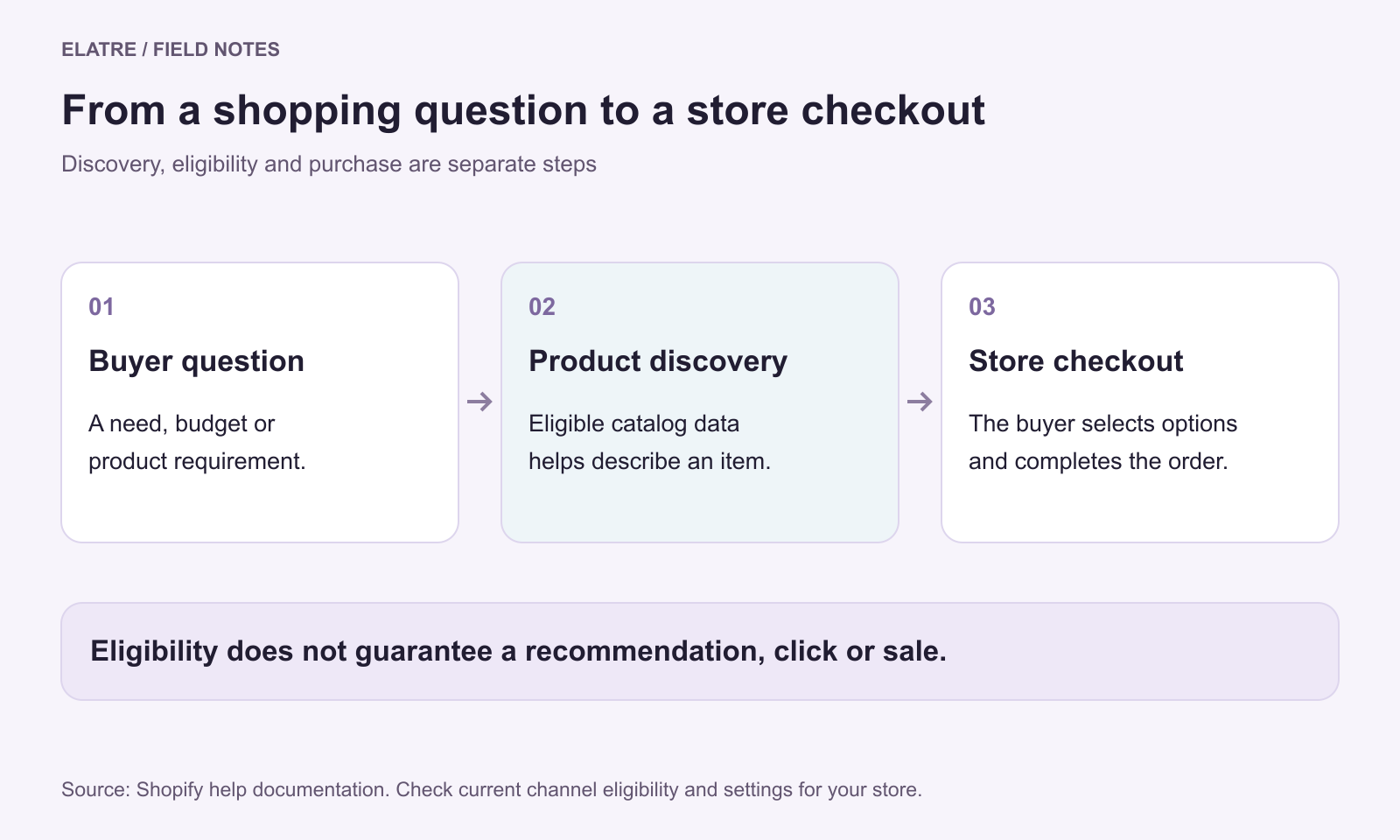
The diagram shows three stages: the shopper’s question, eligible product discovery and the store checkout. At each stage, different things can go wrong. A missing specification affects product suitability; a confusing variant selector affects the purchase; neither is resolved by counting brand mentions.
A useful ecommerce marketing plan checks the entire route. It connects catalog accuracy with the experience a customer receives after leaving the conversation.
Check eligibility before planning a campaign
Shopify’s guidance includes requirements around selling to US customers, eligible products, applicable policies and supplemental terms. A store does not necessarily have to be based in the US to sell to US customers. B2B-only stores are not supported under the requirements described in the referenced guide.
Check the live documentation and the notices in your own admin before relying on a general article. A requirement being satisfied does not mean every product will appear for every relevant question.
| Check | What the merchant should establish |
|---|---|
| Customer market | Whether the store can sell to the supported customer market |
| Product eligibility | Whether the products meet the channel’s requirements |
| Terms and policies | Whether applicable conditions have been reviewed and satisfied |
| Catalog access | Whether the relevant products and information are available to the channel |
| Business model | Whether the store is eligible, including any B2B-only restriction |
Keep a short record of what you checked and when. If the admin shows an eligibility issue, resolve the specific issue rather than buying a general visibility package in the hope that it will override channel requirements.
Know which Shopify controls you are looking at
Shopify’s Agentic storefront documentation explains where to review these channels in the admin. Use the Agentic area under Sales channels for the applicable settings, and follow the controls available to your store. Shop has its own product and channel controls.
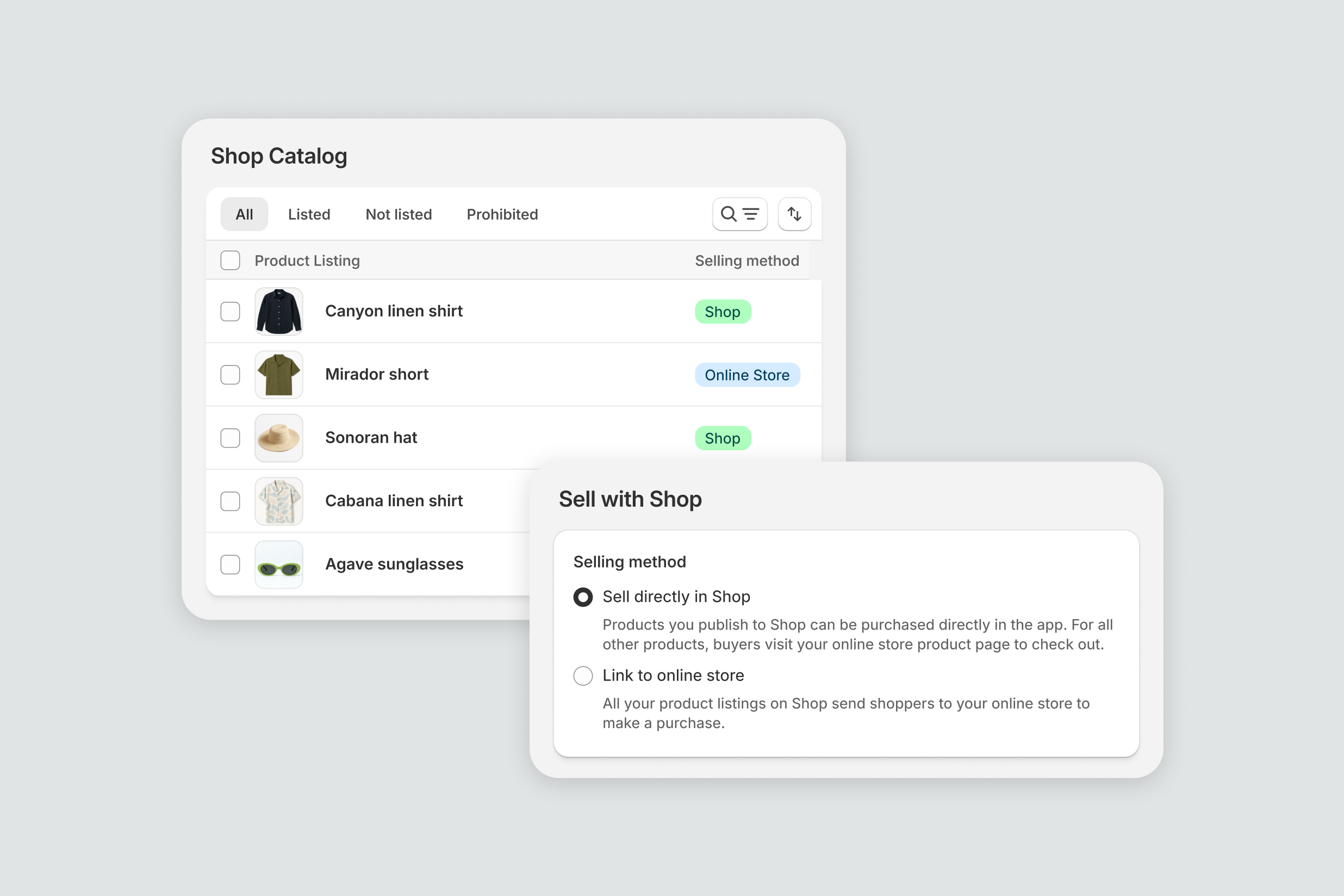
The screenshot comes from Shopify’s guide to customising a Shop presence. It illustrates catalog selling controls in Shop. It is not a screenshot of Agentic settings, and it is not a view of an Elatre client’s store.
That distinction matters when asking a team member to check a setting. Record the exact channel, product and state you are reviewing. A screenshot of a product being available in one channel should not be treated as proof that it is available in another.
Improve the information that describes the product
Use a recognisable product name, accurate category information and concrete specifications. Confirm the selected variant, current price and availability. Delivery and return details should be easy to find and consistent with what the store can actually provide.
Write for a shopper with a particular need. Someone comparing travel bags may care about dimensions, empty weight, compartments and luggage compatibility. Someone buying a replacement part may need exact model information. Broad claims about quality cannot substitute for those facts.
Avoid making universal claims that the product documentation cannot support. If suitability depends on a device model, an airline’s current baggage limits or another external condition, explain that dependency. It is more helpful than declaring the item suitable for everyone.
Worked example: a travel bag with missing buying details
Illustrative scenario, not a measured client result. Imagine a store selling a bag called “The Weekender.” The page includes attractive photos but omits the bag’s external dimensions, empty weight and a clear list of included accessories.
A shopper asks for an under-seat bag for a particular trip. The product might be relevant, but the available information is too vague to establish suitability. The first task is to add the real dimensions and explain the features, then ask buyers to check their carrier’s current restrictions.
The merchant would also confirm that each colour and size maps to the correct variant, that availability is current and that the product remains understandable on a phone. A product name can retain its brand personality while its surrounding information supplies the practical detail.
After the work, the team could run a defined set of discovery checks and review related visits, orders and customer questions. It would record promotions and stock changes during the same period. The scenario describes how to investigate performance; it does not claim that these edits produced sales.
Test the checkout experience after discovery
Walk through the journey on mobile. Can a visitor identify the exact item, choose a variant and see the final conditions clearly? Does the selected option remain the same as the one described earlier? Are delivery costs and relevant restrictions understandable before payment?
Check products with additional complexity separately. Bundles, subscriptions, personalisation and restricted shipping can introduce extra steps. A simple product working correctly does not prove that every purchase path works.
Elatre’s AI SEO services can be discussed alongside this wider website work. The commercial objective should remain a relevant customer reaching an accurate product page and a usable checkout.
Separate readiness, discovery and sales in reporting
| Layer | Example evidence | What it can establish |
|---|---|---|
| Readiness | Eligibility checks and catalog issue records | The store has addressed identified requirements |
| Discovery | Dated product appearances and exact questions | A product appeared under the recorded conditions |
| Traffic | Known referrals and landing-page sessions | A measurable visit reached the store |
| Sales | Orders and conversion context | A transaction occurred, subject to attribution limits |
Keep the exact question, date, market, response and product URL for discovery observations. Use a consistent set of questions over time. If a question names your store, label it as a branded test rather than combining it with unbranded product-selection questions.
For commercial reporting, work with the attribution your analytics and store reports actually provide. Some journeys will have incomplete referral information. Unknown traffic should remain unknown unless you have evidence supporting a different classification.
A useful review ends with a decision: correct inaccurate product information, investigate a checkout problem, expand a promising product group or continue collecting data. A larger collection of screenshots is not a decision by itself.
Common questions
Can a store outside the US be eligible?
The referenced Shopify guide distinguishes a store’s location from the customers it can sell to. Check the current supported market and all other requirements for your store.
Does eligibility guarantee a recommendation?
No. It establishes that the store or products meet applicable conditions. Relevance and the particular shopping question still matter, and a product appearance does not guarantee a click or sale.
Should we pay for an additional service immediately?
First establish what is already available through your platform, whether the catalog is accurate and what work remains. Pay for a defined implementation or measurement need you can evaluate.
Make the product journey easier to trust
Start with eligibility, one useful product group and a working checkout. Request an Elatre visibility audit to discuss the product information and measurement needed to assess this discovery channel.