
Imagine your website as a house. You want visitors to feel welcome and know precisely where to find everything they need. Clear signage, designated rooms, and intuitive organization make navigation a breeze. In web design, HTML semantic tags function much the same way. By using HTML semantic tags, you’re providing structure and meaning to your website’s content. This enhances the user experience and benefits search engines and accessibility. We’ll delve into five key ways HTML semantic tags can elevate your website.
Improved Search Engine Optimization (SEO)
Think of search engines like detectives scouring the web for relevant information. Semantic tags act as helpful clues, guiding search engines to understand your website’s content better. Here’s how:
- Relevance: When you use tags like <article>, <section>, and <header>, you’re explicitly communicating the type of content on your page. This makes it possible for search engines to match your website with pertinent search terms closely.
- Content Hierarchy: Semantic tags establish a clear hierarchy for your content. Headings like <h1> and <h2> indicate the importance of different sections. Search engines use this hierarchy to understand your page’s structure and context.
- Rich Snippets: Rich snippets are informative summaries in search results. Using semantic tags, you may improve the chance that your website will appear in these summaries. Rich snippets often include details like titles, descriptions, and even ratings, making your website stand out and enticing users to click.
Enhanced User Experience (UX)
A well-structured website is easy to use. Semantic tags provide a seamless user experience by providing a clear structure and making content discoverable.

- Intuitive Navigation: Imagine a website where every section is a <div>. It could be more intuitive. Semantic tags like <nav> for navigation menus and <aside> for sidebars create a logical flow, allowing users to find what they’re looking for quickly and efficiently.
- Screen Readers and Assistive Technologies: For websites to be accessible, semantic tags are essential. These tags help screen readers—used by people with visual impairments—understand the organization and goal of the material. By using semantic tags, you’re ensuring your website is accessible to a broader audience.
- Future-Proof Design: As technology evolves, semantic tags provide a foundation for future advancements. Browsers may interpret these tags in new ways to enhance user experience, ensuring your website remains adaptable and user-friendly.
More apparent Website Structure and Maintainability
When you build a website with semantic tags, you create a blueprint. This blueprint helps you and other developers understand how your website’s content is organized.
- Code Readability: Semantic tags make your code more readable and maintainable. Descriptive tags like <article> and <section> are far more meaningful than generic <div> tags. This clarity simplifies future edits and updates, saving time and effort.
- Content Management: Content management systems (CMS) can leverage semantic tags to offer more intuitive content creation tools. For instance, a CMS might automatically format content within a <h1> tag as a large heading. This guarantees consistency throughout your website and expedites the content generation process.
- Team Collaboration: Semantic tags foster clear communication if you’re working with a team of developers or content creators. Everyone involved can easily understand the purpose and hierarchy of different content sections.
Flexibility in Design
One common misconception about semantic tags is that they dictate website design. Thankfully, this isn’t the case. Semantic tags define the meaning of your content, while CSS controls how it’s presented.
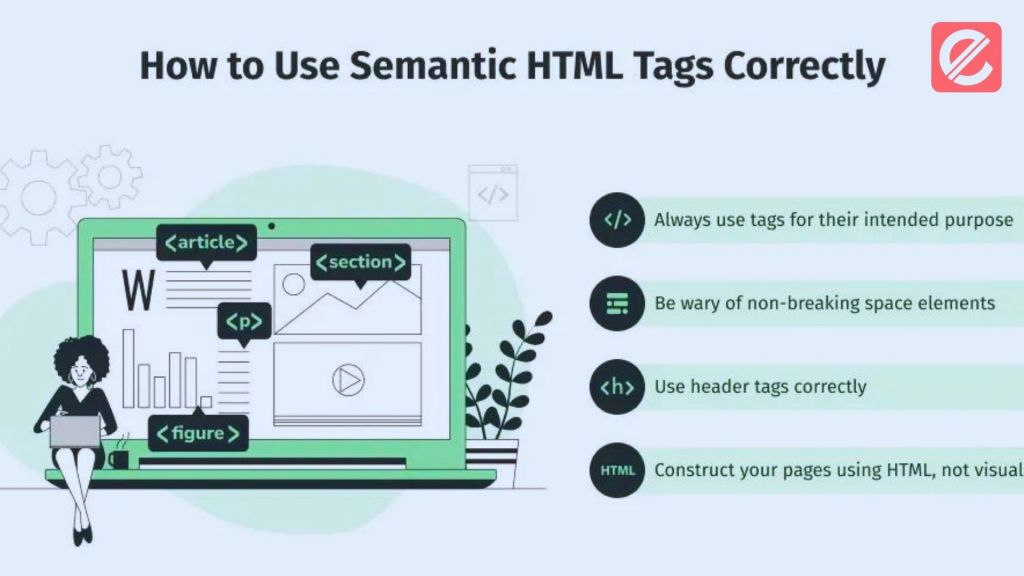
- Separation of Concerns: Semantic tags separate the structure and meaning of your content from its visual presentation, allowing for greater design flexibility. With CSS, you can style your website to have the look and feel you want while keeping its semantic structure intact.
- Responsive Design: In today’s mobile-first world, responsive design is essential. Semantic tags and CSS media queries ensure your website adapts seamlessly across different screen sizes. The clear structure provided by semantic tags makes it easier to adjust layouts for optimal viewing on any device.
- Future Design Trends: Web design trends are constantly evolving. However, with a solid semantic foundation, you can adapt your website’s design to new trends without compromising its core structure or SEO benefits.
Long-Term Website Health
Maintainability and Scalability: A website with a clear semantic structure is easier to maintain and update over time. New content can be seamlessly integrated with existing sections, and future developers can quickly grasp the website’s organization. This makes it easier to scale your website as your business grows, ensuring a smooth user experience even with a more complex website structure.
Accessibility Best Practices: Semantic tags are foundational to accessibility best practices. By using these tags correctly, you’re making your website usable for everyone, regardless of ability. Search engines also recognize websites prioritizing accessibility, potentially giving you an SEO edge.
Voice Search Optimization: Voice search’s popularity changes how people use the internet. Semantic tags play a crucial role in voice search optimization. Search engines leverage the meaning conveyed by these tags to understand the context of a user’s voice query and deliver the most relevant results.

Reap the Benefits: Build a Stronger Website with Semantic Tags
The benefits of using HTML semantic tags are undeniable. They enhance SEO, improve user experience, and make your website more accessible and maintainable. By implementing these tags, you’re creating a visually appealing website that is well-structured, informative, and accessible to everyone.
Just like a well-organized house provides a welcoming and comfortable environment, a website with semantic tags offers a smooth and enjoyable user experience. Using semantic tags to improve your website’s structure will be worth it. You should be proud of your website.
Ready to explore how Elatre can help you leverage the power of HTML semantic tags to elevate your website? Elatre is an innovative digital marketing agency that focuses on developing high-quality websites with a focus on aesthetics and search engine optimization. Our skilled staff can help you optimize your website for search engines by implementing semantic tags. Contact Elatre today for a free consultation and discover how we can help you build an outstanding website.